


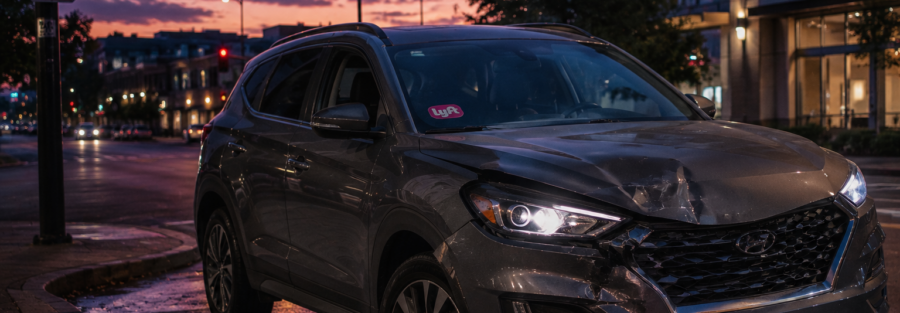
Friday Night Rush: How One Bad Left Turn Cost a Lyft Driver Her Best Earning Week
Jasmine had been driving for Lyft for three years, and Friday nights were her favorite shift.
Friday nights meant surge pricing. Friday nights meant the airport runs, the dinner crowds, the bachelor parties heading downtown. On a good Friday night, Jasmine could clear $200 in five hours of driving. It paid for her daughter’s gymnastics lessons and most of her grocery bill for the week.
She had just accepted her sixth ride of the evening — a 1.8x surge fare heading from a busy restaurant district to the airport — when a driver in a white sedan ran a stop sign and t-boned her from the passenger side.
No one was seriously hurt. The other driver had insurance, but he immediately got combative, claiming he had the right of way. Jasmine knew he didn’t — she had the dash cam footage to prove it — but it didn’t matter for what was about to happen.
Her compact SUV was undriveable. Her Friday night was over. And her $2,500 problem was just beginning.
How Rideshare Insurance Actually Works
Most Lyft drivers don’t fully understand their insurance until they have to use it. Here’s the short version of what kicks in and when.
When you’re driving for Lyft, you move through three different insurance “periods” depending on what you’re doing:
- Period 1: You’re logged into the Lyft app, waiting for a ride request. Lyft provides limited liability coverage, but not damage to your own car.
- Period 2: You’ve accepted a ride request and are on your way to pick up the passenger. Lyft’s full commercial coverage kicks in, including damage to your car — with the $2,500 deductible.
- Period 3: You have a passenger in the car. Same full coverage applies, same $2,500 deductible.
Jasmine was in Period 2 when the accident happened. She had accepted the airport ride and was on her way to pick up the passenger. That meant Lyft’s commercial coverage applied — and so did the $2,500 deductible.
“But the Other Driver Was at Fault”
This is the question every driver asks, and it’s the right question. If the other driver was clearly at fault, why does Jasmine have to pay anything?
In theory, she doesn’t. In practice, it gets complicated.
When the other driver’s insurance accepts liability and pays out quickly, the deductible can sometimes be reimbursed through the subrogation process — the insurance industry’s way of recovering costs from the at-fault party’s insurer. That sounds great. The catch is that subrogation can take months. Sometimes longer. And if the other driver’s insurance disputes liability or has minimum coverage, you might end up paying out of pocket anyway and waiting a long time for any kind of refund.
Meanwhile, your car is in the shop. You can’t drive for Lyft. And the deductible has to be paid to even start the repair.
“I knew I’d probably get the money back eventually,” Jasmine said. “But eventually doesn’t fix my car this week. Eventually doesn’t put gas in my tank or food on my table.”
The Real Damage Was the Time Off
Jasmine’s SUV was in the body shop for nineteen days.
During that time, she didn’t drive for Lyft. She couldn’t. Even if she had a rental, most rideshare companies don’t allow you to drive their platform in a rental car without going through specific approval processes that take time she didn’t have.
She tried to pick up extra shifts at her part-time day job, but her hours were already maxed out. She borrowed money from her mother. She put gas on a credit card for the first time in two years.
By the time her SUV came back, she had paid the $2,500 deductible from her emergency savings, missed almost three weeks of rideshare income, and watched her credit card balance grow for the first time since she paid it off.
The other driver’s insurance, by the way, did eventually accept liability — six months later. She got her $2,500 back. But the lost income, the borrowed money, the credit card interest? That was on her.
What She Tells New Drivers Now
Jasmine still drives for Lyft. She still loves Friday nights. But she does two things differently now.
The first is a dash cam. She bought a good one a few days after the accident, and it stays on every time she’s on the app. The footage from her old, lower-quality camera helped her case but wasn’t perfect.
The second is deductible reimbursement coverage.
For a small monthly cost, her plan reimburses her up to $2,500 per incident — the exact amount of her Lyft deductible. The process is simple:
- An accident happens while she’s logged into the Lyft app.
- She files the claim with Lyft’s insurance.
- The claim is approved, and she pays the deductible to start the repair.
- She submits proof of payment to American Deductible.
- She gets reimbursed for the full $2,500.
“It doesn’t fix the lost income while my car is in the shop,” she says. “But that $2,500 hit? That’s not coming out of my pocket anymore. That’s a huge weight off.”
A Word on Taxes
One more thing Jasmine learned along the way: as a rideshare driver, the cost of deductible reimbursement coverage may be a deductible business expense at tax time. She works with a tax preparer who knows rideshare drivers, and now she keeps track of her premium payments along with her mileage, her phone bill, and her other gig-related deductions.
It’s not legal or financial advice — every driver’s situation is different, and you should talk to a tax professional. But it’s worth asking about.
The Hard Truth About Friday Nights
Friday nights are the best earning nights for most rideshare drivers. They are also some of the riskiest. More cars on the road, more impaired drivers, more pedestrians, more chaos.
You can drive carefully. You can know your routes. You can read the road. But you cannot control the driver running a stop sign at the intersection where you happen to be.
What you can control is what happens to your wallet when the worst happens.
Drive for Lyft or Uber? Don’t wait for your Friday night to teach you the same lesson Jasmine learned. Get a free quote on rideshare deductible coverage today and keep your earnings where they belong — with you.
Note: Rideshare deductible coverage typically requires at least six months of active driving with Uber or Lyft.